

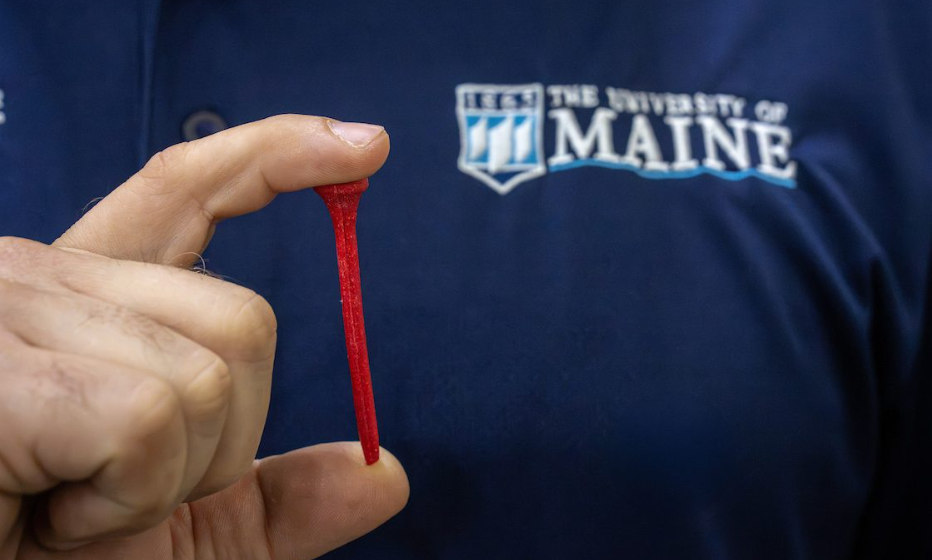
BOSTON, Massachusetts – This story qualifies as one that is so peculiar you can’t make it up! It involves lobster and golf which have zero overlap, until now.
Speaking of lobster, a wise old man once told me that lobster is the only food you can eat all you want & still starve to death.
Speaking of golf, a wise golf pro tells me “drive for show and putt for dough.”
Okay enough cliches, let’s get to the point.
We know a boiled or steamed Maine lobster can end up in a roll, a bisque or a butter bath, but now researchers at the University of Maine have concocted a scientific business model that turns discarded lobster shells into golf tees.
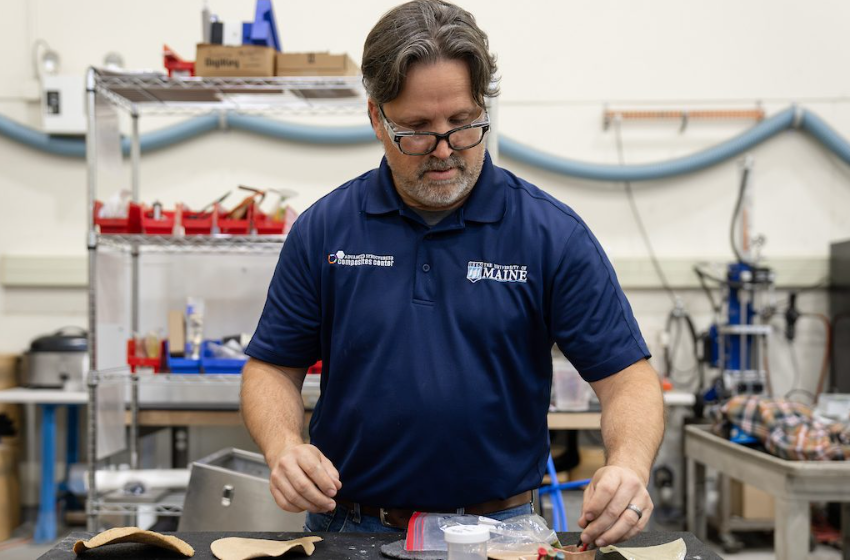
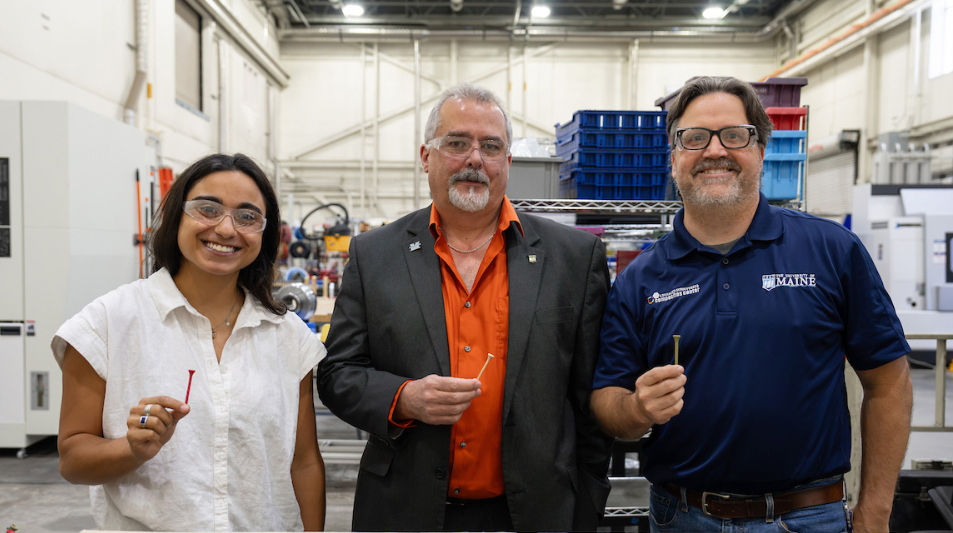
According to a University of Maine research team led by David Neivandt, Gregory Simms and Isabelle Irani, this is a breakthrough invention and win-win proposition for the $1 billion Maine lobster industry and golfers worldwide.
The project has been percolating for more than a decade at UMaine with a mission to boost Maine’s lobster industry.
Maine’s lobster industry generates an estimated 50,000 tons of shells each year, and some processing facilities pay to dispose of them in landfills. UMaine researchers have explored using lobster shell composites in products ranging from agricultural to temporary or single-use products.
With the golf tees, they have created a new economic opportunity across the lobster industry supply chain and one of the state’s signature marine industries.
“What we’re doing in this project is using an underutilized waste material from the fishing industry, from the lobster industry,” said project lead David Neivandt. “We are trying to create value-added products that can return revenues to those lobster fishermen as well as the processing facilities.”
FROM LOBSTER SHELLS TO GOLF TEES
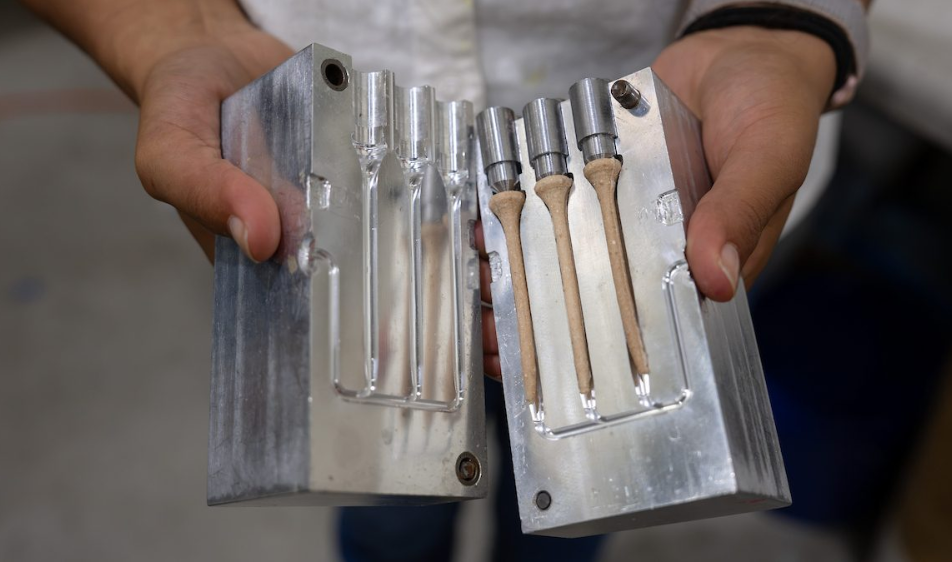
David Neivandt, along with faculty and student researchers are using a proprietary process to combine powdered lobster shells with other natural materials into a solid composite that can be molded into golf tees and other shapes.
The shells are provided by Shucks Maine Lobster Company, dried, broken into pieces, ground and sifted before the powder is incorporated into the composite. Natural food dyes may be added during the mixing process to produce tees in different colors.
Gregory Simms, a doctoral candidate in materials sciences and engineering and staff member at UMaine’s Advanced Structures and Composites Center, has worked on testing and improving the composite.
“Many golf courses just blow broken golf tees into the rough, so when that area gets mowed, the tee material is shredded and left on the soil,” Simms said. “When exposed to the elements on a golf course, the lobster-shell tees break down in about 30 days. By comparison, conventional wooden tees can take years to degrade, while plastic tees can persist much longer. As the composite breaks down, minerals and other nutrients naturally found in lobster shells are released into the soil.”
DESIGNED TO PERFORM AND DESINTEGRATE
The material also has to be strong enough to perform like a conventional tee. Simms said the original composite needed improvement to match the mechanical performance of eastern white pine. Researchers adjusted the production process and added other natural materials, resulting in a composite that surpassed the strength of golf tees traditionally made from eastern white pine.
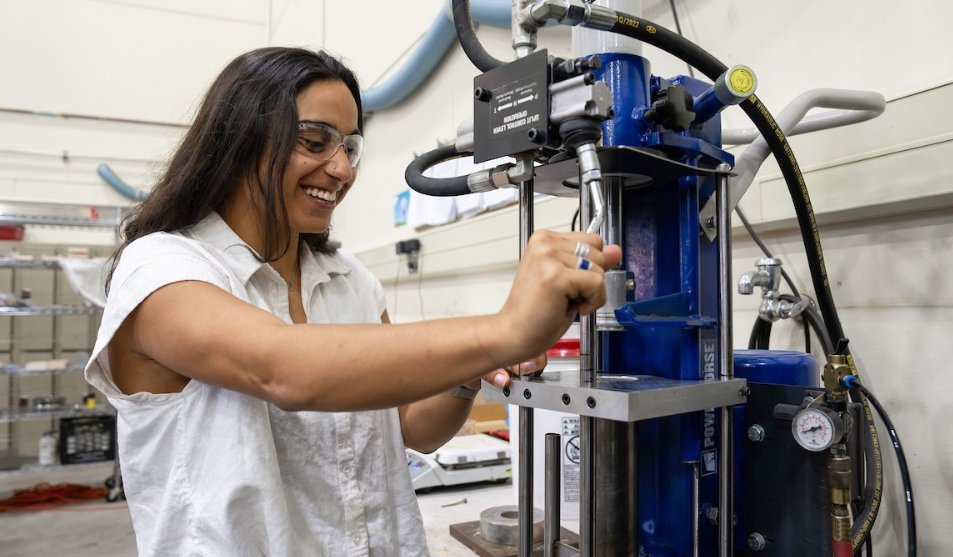
“The production line designed and built in the first year allowed us to make simple processing adjustments and incorporate other natural additives, enabling the composite to exceed eastern white pine in flexural strength, compression strength and shear strength,” Simms said.
SCALING UP A NEW MANUFACTURING PROCESS
The team operates a laboratory-scale injection molding system developed with help from UMaine’s Advanced Manufacturing Center. Because the lobster-shell composite cannot be processed using conventional injection molding equipment, researchers had to develop a system specifically for the material.
“The limitation that we have is that, because of its unusual rheological properties, it is not amenable to traditional injection molding equipment. So we’ve had to build our own injection molding system at the lab scale,” said Neivandt, interim dean of the Maine College of Engineering and Computing.
At the laboratory scale, each tee currently costs an estimated 5 to 30 cents to produce. Researchers hope higher-volume production will lower that cost enough to compete with conventional wood and plastic tees.
The average American consumes 1.2 pounds of lobster each year, with Maine lobster accounting for 80% of that. A survey shows that 65% of consumers in the U.S. prefer Maine lobster over other types when given the choice.
From research project to golf product. Welcome to the world of lobster-shell golf tees!
(PHOTOS: Courtesy of University of Maine)