
by LARRY HALL
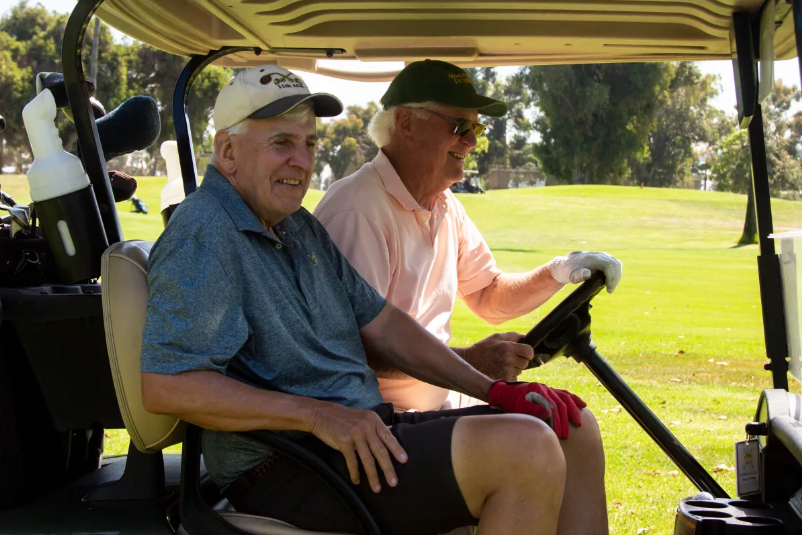
“Good putt Dave.”
For most of us, golf is a difficult game to master. For David Szumowski, it presents a challenge most golfers could never imagine. He plays the game without the benefit of sight, relying instead on sound, touch, memory, and a little help from a friend. The last good putt Dave actually saw was in 1969.
Today, he is one of more than 400 registered blind golfers in the United States. And he doesn’t simply play golf. He plays it well.
Dave’s introduction to the game came much like that of many boys growing up in the 1950s and 1960s. As a youngster in Gloversville, New York, he learned the game while caddying at his local course. He quickly developed a love for golf, never imagining that one day he would have to find a way to play it in darkness.
That dark day came on March 20, 1969, in the jungles of South Vietnam. What followed was a journey through tragedy, recovery, professional achievement, and ultimately, a return to the game he loved.
A SOLDIER’S JOURNEY
When Dave entered college at the University of Richmond, the Vietnam War was escalating. Many young Americans were being drafted, but Dave chose a different path. He enrolled in ROTC as an elective and discovered a genuine interest in military history and the discipline of military training.
By his junior year, he had committed to serving two years in the Army following graduation. His decision was influenced in part by his parents, both of whom had served in the Army during World War II. They had instilled in him the belief that serving one’s country was an honor.
There was also a practical benefit. His $50 monthly Army stipend gave him enough money to purchase his first new car, a Mercury Cougar.
Dave graduated in June 1967 and was commissioned as a second lieutenant in the United States Army. Choosing the Armored branch, he reported to Fort Knox, Kentucky, for training in January 1968.
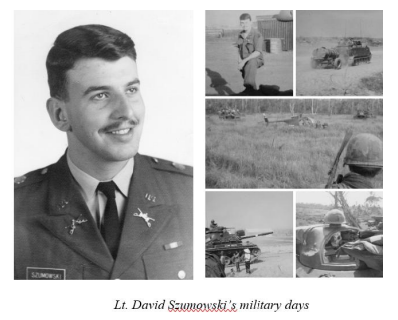
The possibility of being sent to Vietnam, or even being injured or killed, never really entered his thinking. He was focused on becoming an effective officer and learning how to lead soldiers.
At Fort Knox, Dave learned to command tank platoons, both in the classroom and in the field. It was demanding work, with little room for error. While stationed there, he lived in a military apartment next to the post golf course. He took advantage of the opportunity to play whenever he could, using a set of old wooden-shafted clubs.
In February 1969, his training complete, Lieutenant Szumowski boarded a TWA military flight in San Francisco bound for Saigon. The flight attendants were kind, slipping alcohol to some of the still teenagers – knowing many of them would never come home.
His first impression of Vietnam came as he stepped off the aircraft. The heat was overwhelming, like walking in front of a blast furnace. It was quite an introduction to a country that would soon change his life forever.
After a day of rest, Dave received his equipment and was transported by helicopter to a forward base camp, where he would join his tank platoon. There was little time for introductions. The work began almost immediately.
Within a week, his platoon was involved in its first firefight. Fortunately, there were no casualties. After a month at the forward base in Xuan Loc, life had settled into something resembling a routine. Enemy engagements became an occasional part of daily life, alongside writing letters home and taking improvised showers using a one-gallon water bag suspended from the tank’s main gun.
Still, the ever-present reminders of war were difficult to ignore.
Then came March 20, 1969.
THE DAY EVERYTHING CHANGED
Dave was sitting in the turret of his M-48 tank when a radio call ordered his platoon to move into an area under heavy enemy fire. As the leader of five tanks, the newly commissioned lieutenant was about to enter only his second major engagement.
The mission was to relieve an infantry platoon pinned down by enemy fire. Dave was instructed to line up his tanks and advance toward the enemy position. The infantry would follow, using the tanks for protection.
Assuming the infantry was behind them, the tanks charged forward. But the infantry was slow to leave its defensive position. The tanks moved through the enemy position, leaving their rear exposed.
Dave was leading the charge with his tank hatch open, sitting with his head and shoulders above the turret so he could see the other tanks and direct their fire.
Then, without warning, an explosion slammed him forward against the turret.
He lost consciousness. The last image etched in his memory was a chaotic blur of tanks, soldiers, dirt, jungle, and a bright yellow flash.
When Dave awoke later that day at the Bien Hoa field hospital, he learned that surgeons had removed several pieces of shrapnel from his face and eyes. Four of the five tanks had been struck by rocket-propelled grenades. One of those explosions had left Dave with devastating injuries.
His military career was over. More importantly, he would never see again.
Dave was eventually evacuated to Walter Reed Hospital in Washington, D.C., where he spent the next five months. His ophthalmologist offered a measure of hope, suggesting it might take several years to determine whether his sight would return. But the possibility was remote. The reassuring words did little more than prolong the uncertainty.
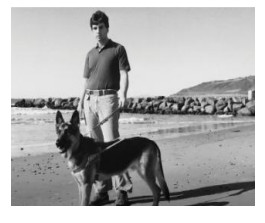
By Christmas 1969, Dave had completed four weeks of training with his new Seeing Eye dog, Jon. Jon became his eyes, his companion, and, as Dave would later joke, a pretty effective chick magnet. Meeting women suddenly became a little easier when he had a dog by his side.
After receiving a medical retirement from the Army, Dave entered the Blind Rehabilitation Program at the Hines VA Center in Maywood, Illinois. His new mission was learning how to live independently in a world he could no longer see.
He learned to navigate with a cane, read Braille, and manage the everyday tasks most of us take for granted. He also discovered how much information could be gathered through his remaining senses. Sounds, smells, and even changes in air movement helped him understand his surroundings.
At first, Dave struggled with his blindness. He was angry, frustrated, and searching for a way to make sense of what had happened. Golf had not disappeared entirely from his life, as he occasionally hit balls into a net. Hitting golf balls offered an outlet for some of that frustration. It was Dave’s way of learning about anger management and PTSD before either one had an official name.
One of the final tests at Hines was a practical exercise in independence. Dave was driven around in a car, taken to an unfamiliar location, and dropped off. His assignment was simple: find his way home.
He did.
FINDING A NEW DIRECTION
Dave applied to several law schools, including his alma mater, the University of Richmond. Richmond rejected his application. What made the rejection particularly painful was a letter from the law school dean suggesting that blind people should not pursue a legal career because the work would be too difficult.
Fortunately, another law school saw things differently.
The University of Denver accepted Dave, and he graduated in March 1973 after three years of study.
The years immediately following law school were difficult. Without a clear career direction, Dave spent much of his time reading, watching television, and drinking beer. He eventually recognized that he was unhappy and needed a fresh start.
He moved to San Diego, attracted by its large military presence and access to VA medical facilities. He began working as a VA benefits counselor and later held several positions with veterans’ assistance programs.
Passing the California Bar Exam proved to be another challenge. After a couple of attempts, he finally succeeded in May 1982.
In March 1986, Dave was hired as a deputy district attorney with the San Diego District Attorney’s Office. He spent the next eleven years prosecuting cases and working in several positions within the office.
It was there that he became friends with George Beall. That friendship would prove important for another reason. George encouraged Dave to return to the golf course and helped him find a way to play the game again.
Dave was also beginning to recognize that his career might take another turn.
He believed he could make a good judge and applied to the Governor of California for an appointment. On March 20, 1998, he was sworn in as a Municipal Court judge.
The date was no ordinary coincidence. It was exactly 29 years to the day after the explosion in Vietnam that had changed his life.
Dave would spend the next 18 years serving as a California Municipal and Superior Court judge. He estimates that he presided over about 200,000 cases during his time on the bench.
Looking back, he believes many of the people who appeared before him were not bad or evil. They were just people who had made poor decisions and were now facing the consequences. Some accepted responsibility, seeking a lower sentence; others maintained their innocence.
Dave’s philosophy was straightforward: get the facts right, make fair decisions and let the punishment fit the crime.
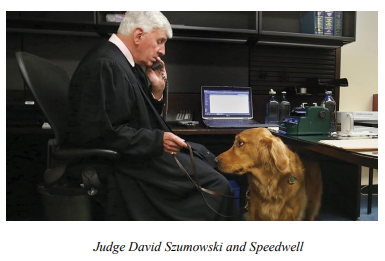
After 18 years on the bench, he retired and eventually moved to Jacksonville, Florida. Today, he is a member of St. Johns Golf & Country Club, where he plays regularly.
And that is where our paths crossed.
SEEING GOLF DIFFERENTLY
I first heard about Dave through my good friend, Dr. Tony Parker, a well-known golf historian. Tony is always sharing golf stories with our group, and he is not generally one to exaggerate.
But when he began telling us about playing golf with a man who was totally blind, I nearly threw the B.S. flag.
It had simply never occurred to me that a blind person could play golf.
A little research changed my mind. I learned that the United States Blind Golf Association (USBGA) has hundreds of registered members who compete in organized tournaments. Some even shoot par or better under the association’s rules. And no, they don’t all play from the forward tees. Some play from the tips.
Now convinced that blind golf was very real, I contacted Dave and asked whether I could join his foursome sometime to see how it worked. He graciously agreed.
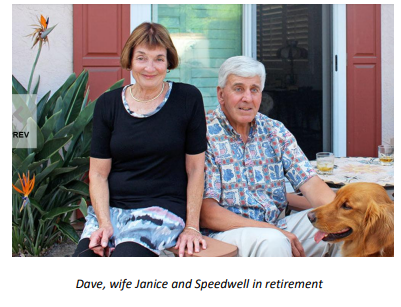
Watching Dave play was an eye-opening experience, although that expression seems a little ironic in this case.
Blind golf does require assistance. A sighted helper walks the player to the ball, helps position him, and aligns the clubface so the golfer is properly addressed to the ball and pointed in the
intended direction.
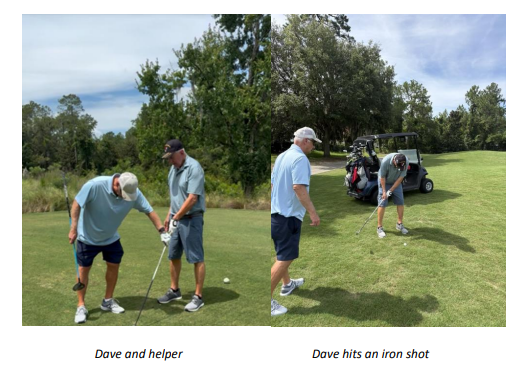
After that, Dave the golfer takes over.
Dave doesn’t hit every shot perfectly. A few find their way off course, but no more often than you might expect from a typical recreational golfer. His drives travel approximately 180 yards, and his 7-iron carries about 125 yards.
I found myself paying particular attention to his setup. Like many golfers, I occasionally struggle with getting the clubface square at address. So, I asked Dave how he knows when his clubface is properly aligned.
His answer was ingenious.
Each of his grips has a small piece of rubber extending from the bottom. When he places his hands on the club, the rubber provides a tactile reference that tells him the clubface is square. It is a simple solution to a problem that many sighted golfers never give a second thought.
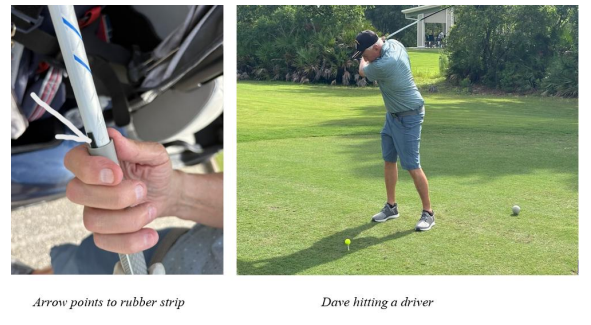
I was impressed not only by Dave’s technique, but by how comfortably he went about his game.
He knew what he wanted to do, trusted his feel, and swung the club.
When I asked him to describe his game in his own words, he explained:
“Sure, I need some sighted help with my setup, direction and club placement, but after that, it’s totally up to me.”
He relies on the feel of the club striking the ball and the sound it makes to judge the quality of his shots.
And he doesn’t get too worked up over the results.
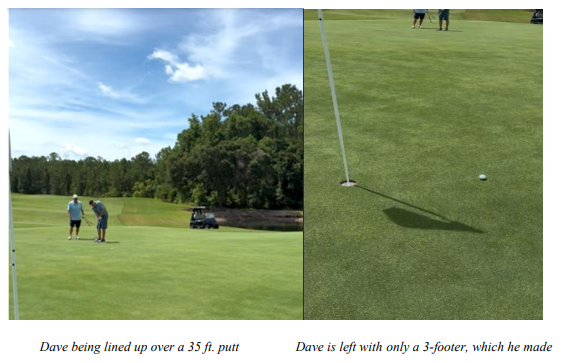
“Win or lose, golf is a great deal of fun for me and gets me out of the house. I’ve learned not to take myself too seriously when playing golf.”
That may be the best golf advice I’ve heard in a long time.
A LESSON FOR THE REST OF US
I thoroughly enjoyed my day on the course with Dave. It reminded me of the message behind the familiar words, “Never Give Up.”
When asked to apply those words to his life, Dave offered, “You may not be what you thought you were going to be,” he said. “But you can still have a very happy and successful and meaningful life.”
His story is about far more than golf. It is about a young Army officer whose life was changed in an instant, a man who refused to let blindness define his future, and someone who found a way to return to a game that had always brought him joy.
Most of us spend far too much time worrying about our score, a missed putt, or a bad swing. Dave has a different perspective. He plays because he enjoys the challenge, the companionship, and the opportunity to get outside.
Perhaps we could all learn something from that.
So the next time you miss a four-footer, send a drive into the woods, or complain about your handicap, remember Dave Szumowski.
Be thankful for what you have. Enjoy the game. And don’t take yourself too seriously.
After all, you may be walking in your own FootJoys, but Dave is playing in his without ever seeing where he’s going.
NOTE ABOUT DAVE’S STORY
David Szumowski has written a book chronicling his remarkable life journey. Titled “Reach for More: A Journey from Loss to Love and Fulfillment,” it offers a much deeper look at the experiences behind this story. The book is available through Amazon. https://www.amazon.com/dp/B07P13ZCV8?lv=shuf&channelId=500&plpRedirect=mhFallback
For more information about blind golf, visit the United States Blind Golf Association https://usblindgolf.com/
(Larry Hall, a Jacksonville, Florida-based golf writer, is a member of Golf Heritage Society, Golf Writers Association of America, Historical Writers of America, International Network of Golf and Golf Travel Writers of America. He can be reached at: bgtriptips@gmail.com)